Seminar for planners, operators, and specialists in cooling and electrical engineering
Deep Dive – Power Supply & Cooling according to EN 50600
Calculating, designing, and assessing data center cooling and power supply: from the cooling load balance to power quality, from the UPS to the metering concept
At a glance
In five days, you learn how the cooling and power supply of a data center work physically and electrically, how they are designed, and where their limits lie: from heat transfer, pressure loss, and the cooling load balance through grounding systems, power quality, UPS, and battery storage to the metering concept according to EN 50600.
You can then verify designs by calculation, assess third-party designs and quotations, and justify decisions on both disciplines with figures.
The cooling part
The seminar goes into the two disciplines that determine the availability and energy efficiency of a data center. The cooling part leads from thermodynamics and fluid mechanics through valves, pumps, and hydraulic balancing to the psychrometric (h,x) chart, refrigeration, and waste heat recovery.
The electrical part
The electrical part covers supply structures, grounding systems, and power quality, the main components from medium voltage to the UPS, battery storage, residual current monitoring, and grounding and equipotential bonding.
Measuring and calculating
The metering concept according to EN 50600, energy management, the German Energy Efficiency Act, and AI in cooling technology connect both disciplines. In calculation exercises, you apply what you have learned yourself.
Depth in the training path
It is the seminar that takes the Data Center Specialist training path into the depth of the two disciplines: one week devoted entirely to cooling technology and power supply.
Why power supply & cooling?
Power supply and cooling are the disciplines on which EN 50600 bases the availability of a data center.
If you can calculate both disciplines, you build in reserves where the Availability Class requires them and nowhere else.
This saves you installations that work on paper but fail in operation due to pressure loss, cavitation, or fault currents, and protects you from quotations you cannot verify. For this, the seminar gives you five days of thermodynamics, hydraulics, and electrical engineering for the data center, with calculation exercises, taught by trainers who know both disciplines from their own design and modernization projects.
Disturbances have a direct effect
According to EN 50600-2-2, disturbances of voltage, current, and frequency directly affect operational safety and availability; according to EN 50600-2-3, excessive fluctuations in temperature and humidity directly affect the functioning of the data center.
Design and measurement
Both parts require a design that supports at least the Availability Class selected for the data center, and both require measurements from which energy efficiency can be demonstrated.
More than the terms
Anyone who implements these requirements in design, tendering, or operation needs more than the terms. They must calculate heat flows, pressure losses, and cooling load balances, assess grounding systems and power quality, understand the standby generator, UPS, and battery storage as an overall system, and set up a metering concept that delivers reliable KPIs.
Tolerance saves energy
EN 50600-2-3 itself states: where wider tolerances for temperature and humidity are permissible, energy can be saved. This requires that you know where the limits of your installation lie.
Who it is for
Who is this seminar for?
Design engineers for power supply and cooling technology
who design installations for data centers, size piping networks and power distribution, and check quotations.
Facility managers and operations managers of data centers
who run cooling and electrical installations, interpret measured values, and assess maintenance, conversions, and extensions.
Technical specialists for data center infrastructure
in electrical and cooling technology who want to move from the individual component to the overall system of both disciplines.
Project managers with a technical focus in data center construction
who assess and accept the work of specialist designers and contractors.
Employees of manufacturers and system integrators
of data center infrastructure who discuss design, grounding system, and metering concept with planners and operators.
Technical consultants and auditors
in the data center environment who assess cooling and power supply concepts against EN 50600.
We recommend the seminar Data Center – General Principles or comparable knowledge of the disciplines, Availability Classes, and the fundamentals of cooling and electrical engineering in the data center; General Principles establishes the level on which this seminar builds. The seminar involves a lot of calculation; formulas and charts are introduced, and a basic technical understanding is assumed.
Trainers and credentials
Trainers who work on current projects
The trainers on this seminar come from real projects; they have applied what they teach in their own data center projects. Which trainers lead a date depends on the date and format; the content is the same.
Vendor-neutral
DCE academy does not sell products and does not represent any manufacturer. Its only aim is to pass on knowledge and train people well, with experts who know their subject from ongoing projects. Products are not sold in the seminar.
First-hand standardization work
DCE academy is the exclusive sponsor of the ISO/IEC 22237 working group and is informed about every meeting of the standards committee and its content. Changes to EN 50600 and ISO/IEC 22237 are incorporated into the seminars, often months before publication. Member of the German Datacenter Association.
- Training since 2007
- for the planning, construction, and operation of data centers
- More than 1,000 participants
- with a DCE academy certificate
- More than 25 experts
- among our trainers
- 98% of participants
- rate their seminar as good or very good (feedback forms 2023–2026)
What you will take away
After the seminar you will be able to
calculate heat transfer, flow, and pressure loss in piping and duct networks, select and size valves and pumps, determine static and dynamic hydraulic balancing, and avoid damage from cavitation and oxygen ingress;
plot air conditions in the psychrometric (h,x) chart, read heating, cooling, humidification, and dehumidification as processes, determine humidifiers and cooling capacities, and draw up the cooling load balance of a computer room;
assess refrigeration, cooling variants, and waste heat recovery by energy efficiency, define the outdoor air flow rate, and classify the PUE as a KPI of cooling;
assess supply structures of general, safety, and UPS supply, grounding systems from TN-S to IT, and power quality according to EN 61000-2-4, and plan the main components from the medium-voltage switchgear through transformer, low-voltage main distribution, and standby generator to the UPS as an overall system, including redundancy concepts such as 3N/2;
assess battery storage from the UPS battery to storage in the megawatt range by service life, temperature, and aging, and classify the requirements for lithium-ion systems;
apply residual current monitoring according to DGUV Regulation 3 and EN/IEC 62020 and grounding and equipotential bonding according to DIN VDE 0100-540 and EN 50310 in the data center;
set up a metering concept according to EN 50600-2-2, 2-3, and 4-2, derive KPIs such as the PUE reliably, apply energy management according to CLC/TR 50600-99-1, assign the obligations of the German Energy Efficiency Act, and classify savings potentials from AI in cooling technology.
Seminar 4 of 4 in the Data Center Specialist training path
After passing the exams of all four seminars, you receive the Data Center Specialist certificate. This seminar can be booked on its own.
Content
Six modules
The six modules follow the path of energy through the data center: from the heat that has to be removed through hydraulics and refrigeration to the power supply that carries everything, and to the metering concept that makes both disciplines assessable.
Every cooling system begins with heat that has to be transported. The module lays the physical foundations and carries them over into the design of piping networks, valves, and pumps.
- Tasks and requirements for data centers, typical cooling system configurations, conservation of energy and the laws of thermodynamics, legal situation
- Heat transfer: calculating forced convection and heat conduction, specific heat capacity of water-glycol mixtures, volume flows, frost protection
- Fluid mechanics: laminar and turbulent flow, dynamic pressure and resistance coefficients, pressure loss calculation for piping and duct systems, assessing the work of third parties
- Valves: types, valve authority, kv and kvs value, throttling with two-way valves and mixing with three-way valves
- Static and dynamic hydraulic balancing, basic circuits, throttling elements; pumps as wet-rotor and dry-rotor pumps, pump circuits, cavitation, and pressure maintenance
Whether a computer room stays within the limits for supply air temperature and humidity is decided by air conditions and the cooling load balance. The module leads from the psychrometric (h,x) chart through the refrigeration cycle to the assessment of cooling variants and the use of waste heat.
- Psychrometric (h,x) chart: latent and sensible heat, process lines with heating, cooling, humidification, and dehumidification; determining air flows, air treatment stages, humidifiers, and cooling capacities
- Refrigeration: refrigeration cycle, components of different chillers, selecting the compressor for each application, humidity control, heat rejection systems, and indirect free cooling
- Drawing up the cooling load balance for the computer room from internal and external loads, PUE value, assessing cooling variants by energy efficiency, determining the outdoor air flow rate
- Waste heat recovery: assessing local heating networks and their connection points, outlook on water-cooled processors
The chosen supply structure determines availability and redundancy paths in the data center, and the components from medium voltage to the power strip must be planned as one system. The module connects grounding system, power quality, and main components into a design according to EN 50600-2-2.
- Supply structures: general, safety, and UPS supply along the supply paths; TN-S, TN-C, TN-C-S, TT, and IT systems and their effect on EMC, safety, and availability; the TN-S system as the target system with separation of N and PE and limit values at the central grounding point
- Power quality: environment classes according to EN 61000-2-4, voltage dips, harmonics, and frequency deviations; measurement and automation technology, storage, and UPS as prerequisites for stable power quality in volatile supply structures
- Main components: medium-voltage switchgear with pressure relief, design and parallel operation of transformers, low-voltage main distribution with selectivity, arc fault protection, and withdrawable technology, busbars and power strips in a continuous TN-S system with an EMC concept
- Standby generator: tasks, control power, load profile, low load, and fuel logistics; static and dynamic UPS with selectivity, autonomy time, energy efficiency, and redundancy concepts such as 3N/2
Batteries age with temperature and cycles, fault currents can be detected before they lead to shutdown or fire, and without grounding and equipotential bonding there is neither personal protection nor immunity to interference. The module covers the three topics that determine the service life, availability, and safety of the power supply.
- Battery types for UPS systems (VRLA, VLA), influence of time, temperature, and number of cycles on service life; lithium-ion batteries with their own extinguishing and protection concepts
- Battery storage in the megawatt range: modular design, power and energy content, aging, loss and standby power in the efficiency assessment
- DGUV Regulation 3 (German statutory accident insurance): avoiding shutdowns of fixed installations through permanent residual current monitoring (RCM) according to EN/IEC 62020; relationship between RCM, RCD, fire protection, and availability
- Grounding and equipotential bonding: system, protective, and functional earth, earthing arrangement and meshed equipotential bonding, reinforced protective conductors, requirements according to DIN VDE 0100-540 and EN 50310, implementation on cabinets, racks, and doors
Without measurement, there is no reliable KPI and no proof of energy efficiency. The module shows which quantities must be measured in the data center, how the PUE according to EN 50600-4-2 is derived from them, and how energy management according to CLC/TR 50600-99-1 leads to improvements.
- Measured quantities in the data center: electrical quantities, temperature, humidity, pressure, VOC, and weather data; ultrasonic flow measurement and statistical values for determining installations
- EN 50600-4-2: the PUE as power usage effectiveness, categories and measurement points for each distribution level; a metering concept according to EN 50600 as the basis for comparable KPIs
- Digitalization of the infrastructure: meeting requirements from SLOs and SLAs such as residual current limits, transients, and cold aisle temperature through systematic monitoring
- CLC/TR 50600-99-1: recommended practices covering the building, mechanical and electrical facilities, computer room, racks, IT, and software; monitoring of electrical energy in new builds and refurbishments; example of computer room air handling units; CLC/TS 50600-5-1 as a maturity model for energy management
The German Energy Efficiency Act (EnEfG) sets the legal framework for monitoring and efficiency of data centers in Germany; sensors and machine learning provide the tools to meet it. The module concludes with the obligations under the act and a live demonstration of AI‑based control of cooling technology.
- EnEfG: requirements for data centers, monitoring and KPIs as a contribution to the requirements, guidance on the data points in the data center register
- Sensors in the cold and hot aisle, on power meters, chillers, and weather station as the data basis for machine learning models
- Predictive maintenance, process control, anomaly detection, automated quality control of SLAs, and energy optimization; savings potentials of AI‑based cooling technology and tools to assess them for software and AI‑based measures
- Live demonstration of an AI‑tool for data centers
Standards and practice
Standards, laws, regulations
The seminar covers the following standard parts, laws, and regulations:
EN 50600‑2‑2 Power supply and distribution
Conformance (Clause 4), functional elements sources, devices, and paths (Clause 5), general requirements and Availability Class (Clause 6), power quality, measurement points by granularity level (Clause 8)
EN 50600‑2‑3 Environmental control
Functional elements in supply and distribution, requirements for design and outdoor conditions, limits for supply air temperature, humidity, and air quality in the computer room, measurement of temperature, flow, and heat removed (Clause 8)
EN 50600‑4‑2
Power usage effectiveness (PUE), categories, and measurement points
CLC/TR 50600‑99‑1
Recommended practices for energy management and energy efficiency; the content has been transferred to CLC/TS 50600-5-1
CLC/TS 50600‑5‑1
Maturity model for energy management and environmental sustainability
EN 61000‑2‑4
Environment classes for power quality
DIN VDE 0100‑410
Protective measures in the IT system (grounding system)
DIN VDE 0100‑540
Grounding, protective and functional equipotential bonding
EN 50310
Telecommunications equipotential bonding
EN/IEC 62020
Residual current monitoring devices (RCM)
DGUV Regulation 3
Periodic testing of fixed installations (German statutory accident insurance)
German Energy Efficiency Act (EnEfG)
Obligations for data centers, data center register
How it works and prerequisites
How does the seminar work?
Two formats, one price
Five seminar days, as an in-person seminar or as a live webinar. In both formats, you learn the same content at the same price; when you register, you choose the format that fits your schedule.
Seminar times and materials
The first seminar day usually starts at 10:00, the following days at 09:00; the seminar ends at around 17:00, and at around 13:00 on the fifth day. You receive the seminar materials as a PDF in the language in which the seminar is held.
Calculation practice
Cooling technology and power supply are taught by trainers from the respective field. Part of the time is calculation practice: in exercises, you apply the formulas to installations and parts of installations, and the solutions are discussed together.
In person
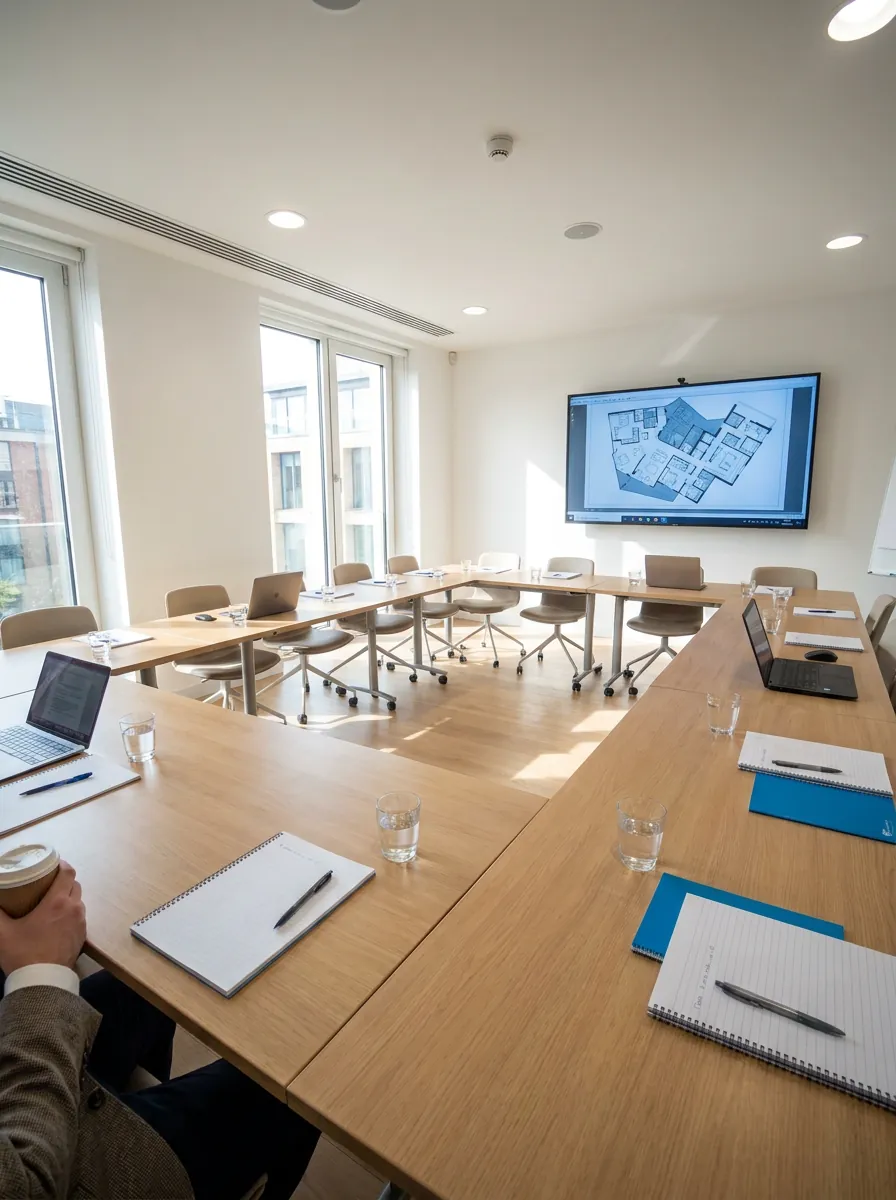
In-person seminars include drinks, coffee, and lunch, and there is time to talk with the other participants and with the trainers, who have real project experience.
Exam and certificate
After the seminar, you receive the link to the online exam by email and have one week to take it. When you pass, you receive the seminar certificate, which does not expire and can be verified publicly; you will find the seminar materials and the certificate in DCE Campus.
Prerequisites: General Principles recommended
We recommend the seminar Data Center – General Principles or comparable knowledge of the disciplines, Availability Classes, and the fundamentals of cooling and electrical engineering in the data center, because this seminar builds on that level. In the Data Center Specialist training path, it follows Data Center Design & Implementation; you can take it before or after Data Center Operations – Professional. The calculation exercises assume a basic technical understanding; formulas and charts are introduced in the seminar.
Dates and registration
Choose a date and format
Same content, same price, same certificate in every format.
€6,990 per participant, plus VAT, in every format
Your date
- Date
- Format and location
- Live webinar · online
- Language
- English
Registration
Deep Dive – Power Supply & Cooling
€6,990
Price plus VAT at the statutory rate.
Date:
23/11/2026 - 27/11/2026
Format:
Webinar
Language:
Seminar price:
€6,990
More dates
In person · Frankfurt am Main · German
fully booked
- Register
Live webinar · online · English
- Register
In person · Frankfurt am Main · German
- Register
Live webinar · online · English
- Register
In person · Frankfurt am Main · German
No suitable date, or several participants from one company? Thomas Wawra advises you on dates, formats, and framework agreements.
Before you register
Frequently asked questions
It is recommended but not mandatory. General Principles establishes the level in cooling and electrical engineering on which this seminar builds. If you bring this from your training and your own work, you can start directly; in the Data Center Specialist training path, Deep Dive – Power Supply & Cooling is the fourth of four seminars, and you can take it before or after Data Center Operations – Professional.
The physics and the design behind it: heat transfer, flow and pressure loss, valves, pumps and hydraulic balancing, air conditions in the psychrometric (h,x) chart, refrigeration and the refrigeration cycle, the cooling load balance, cooling variants by energy efficiency, the outdoor air flow rate, and waste heat recovery. In calculation exercises, you apply what you have learned yourself.
The supply structure of general, safety, and UPS supply, grounding systems and power quality, the main components from the medium-voltage switchgear through transformer, low-voltage main distribution, and standby generator to the UPS, battery storage, residual current monitoring, grounding and equipotential bonding, and the measurement points according to EN 50600-2-2.
Regularly, especially in the cooling part. In exercises, you verify designs by calculating them yourself; the formulas and charts are introduced in the seminar, and the solutions are discussed together. A basic technical understanding is assumed.
Yes, from the perspective of the two disciplines. The supply structure determines the redundancy paths of the power supply, UPS systems are planned with redundancy concepts such as 3N/2, and according to EN 50600-2-2 and 2-3, power supply and environmental control must support the Availability Class selected for the data center. Deriving the Availability Class from the business risk analysis is covered in the seminar Data Center Design & Implementation.
As a live webinar, yes: the in-person seminar and the live webinar teach the same content at the same price, with the same exercises, the same exam, and the same certificate; you choose the format when you register. The seminar is currently not offered as a video course. It is held in English as a live webinar; the in-person dates are held in German. The language and format are shown for each date.
Yes. DCE academy does not sell products and does not represent any manufacturer; no products are sold in the seminar. Its aim is to pass on knowledge and train people well, with experts who know their subject from ongoing projects.
After passing the exam, you receive a seminar certificate from DCE academy. You receive the link to the online exam by email after the seminar and have one week to take it. The certificate does not expire, can be verified publicly, and counts as one of the four seminars toward the Data Center Specialist certificate; if you have already completed Data Center – General Principles, Data Center Design & Implementation, and Data Center Operations – Professional, this seminar completes the training path.